Oman

Oman is a place full of contrasts, from the rugged beauty of the desert to the picturesque coastal towns along the Arabian Sea. One of my top recommendations is a visit to the capital, Muscat, which is known for its impressive architecture and laid-back atmosphere. The Sultan’s Palace and the Grand Mosque of Sultan Qaboos are particularly impressive.

Another highlight is a drive through the Wahiba Desert, known for its red sand dunes and spectacular scenery. There, you can also spend the night in a Bedouin camp and experience the country’s traditional culture and cuisine.

For adventure seekers, there are numerous options, such as a hike through Jebel Shams, Oman’s highest mountain, or a rock-climbing trip in Wadi Bani Awf. Those who love the water can go snorkeling or scuba diving to experience Oman’s breathtaking underwater world.

And let’s not forget the country’s rich culture and history, which can be seen in places like Nizwa, one of Oman’s oldest cities, and the ancient port town of Sur.

In summary, Oman offers a unique blend of adventure, culture, and nature, making it an unforgettable travel destination.


Highlights in Oman

There are so many interesting places to discover in Oman that it’s hard to list them all. However, here are some of the top places you definitely shouldn’t miss:

  1. The Grand Mosque of Sultan Qaboos in Muscat: This impressive mosque is one of Oman’s most famous landmarks and features breathtaking architecture and a fascinating interior.

  2. The city of Nizwa: One of Oman’s oldest cities, known for its forts, souks, and traditional crafts.

  3. Jebel Shams: Oman’s highest mountain, offering breathtaking views and hiking trails.

  4. The Wahiba Sands Desert: The red sand dunes offer an unforgettable experience, especially when spending the night in a Bedouin camp.

  5. The city of Sur: A historic port town known for its traditional dhow shipbuilding.

  6. The Bimmah Sinkhole: A natural crater with emerald-green water, ideal for swimming and snorkeling.

  7. The coastal city of Salalah: Known for its green landscapes, waterfalls, and beaches, as well as its annual Khareef season, when monsoon rains transform the area into a green oasis.

  8. The village of Misfat Al Abriyyin: A picturesque mountain village with terraced fields and traditional mud-brick houses.

These places are just a few of the many highlights Oman has to offer, and there is so much more to discover.

 Location

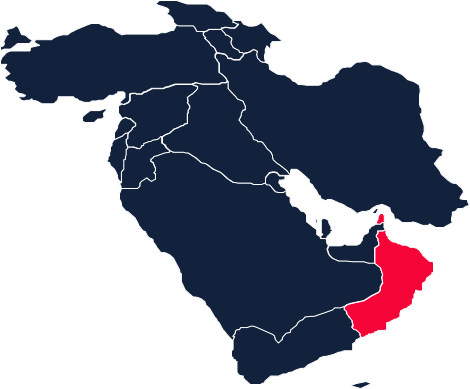
Oman is located in the Middle East on the southeastern coast of the Arabian Peninsula. It borders the United Arab Emirates to the northwest, Saudi Arabia to the west and Yemen to the southwest. The Arabian Sea lies to the east and the Gulf of Oman to the north. Oman covers a total area of approximately 309,500 square kilometres.

 Entry requirements

German citizens can enter Oman for certain tourist, business or private visits without obtaining a visa in advance, depending on the duration and conditions of the stay. Visa-free entry for up to 14 days may be possible under certain conditions, such as proof of a return ticket and hotel reservation. A passport with sufficient remaining validity is required. Further information is available from the German Federal Foreign Office.

 Apply for a visa:

eVisa

  Safety:

low       high

 Getting around

  Public transport:

Price:
cheap       expensive
from approx. €3

Availability:
low       high
Buses, mainly in Muscat

Safety:
low       high


  Taxi:

Price:
cheap       expensive
No fixed fares; agree the price before departure

Availability:
low       high

Safety:
low       high


  Rental car:

Price:
cheap       expensive
average from approx. €40 per day

Availability:
low       high

Safety:
low       high

 More information

  Official language: Arabic

  Population: 4,580,000 (2022)

  Currency: Omani rial (OMR)

  Capital: Muscat

  Largest airport: Muscat International Airport (MCT)

  Time difference: German winter time +3 hours / summer time +2 hours

  Public holidays: Sultan accession celebrations, Isra and Miraj, Eid al-Fitr, Eid al-Adha, Muharram, Mawlid an-Nabi, National Day and National Day holidays

  Climate

 Subtropical, dry and hot

 Best time to visit: November to March


Oman has a predominantly dry and hot climate, with high temperatures throughout much of the year. The summer months from May to October are particularly hot, with average temperatures of around 35 to 40 °C. The southern part of the country can also experience seasonal monsoon conditions. The winter months from November to April are generally cooler, with average temperatures of around 20 to 25 °C.

Coastal areas have a subtropical climate, while much of the interior has a desert climate. Rainfall is generally low, and large parts of the country are characterised by desert landscapes.

Because of the high summer temperatures, November to March is generally a popular time to visit Oman. Temperatures are milder during this period, which can provide more comfortable conditions for sightseeing and outdoor activities.


Muscat
 

 JanFebMarAprMayJunJulAugSepOctNovDec
Min. °C171720242830292826242018
Max. °C252729343940383635353027
Rainy days634201111123
Sunshine hours per day99991099991099
Water °C242325273031313130292826